Although many people travel for business and pleasure without experiencing issues, severe problems can arise that require medical repatriation. This is the process of arranging medical transport from a person’s foreign destination to their home country due to an accident. Relatives are often the ones who must make these plans, mainly because the affected person cannot assume responsibility. What are the steps for responsible parties to take, and why do these actions make the overall process go more smoothly?
Advocate for the Person Requiring Transport If Necessary
Anyone who has ever had a minor injury abroad knows how overwhelming it feels to be in an unfamiliar place during those times. Language barriers can even make it difficult to handle basic tasks like requesting over-the-counter painkillers from a pharmacy or finding the nearest health clinic and verifying its opening hours.
These difficulties become magnified when someone is in such a critical condition that they need medical transport home. Depending on where someone traveled, obtaining information about their condition may pose initial challenges, requiring relatives to act assertively and advocate for those who are hurt.
Getting details about why the best option is to have the person return home is also valuable. It is often the case that the destination country lacks the specialized care the individual requires. In other cases, it is soon apparent that the recovery will be so long or physically intensive that the person would be more comfortable if going through the process in the country where they live.
Sometimes, it is also prohibitively costly to receive anything more than stabilizing care in the place where someone traveled. This barrier is particularly likely if the party who has had an accident must abide by specific insurance requirements, such as receiving care only from in-network providers.
Assisting a person who needs to come home due to a medical emergency is a highly individualized activity. It may require finding a translator who can communicate with providers in the foreign country, offering emotional support or even speaking on behalf of the affected person if that legal right exists.
Calculate the Approximate Costs
When relatives begin researching the potential costs, they soon learn about the many variables. Firstly, some entities only offer medical evacuation, which merely involves transferring a patient to the nearest appropriate facility in an emergency. Medical repatriation is more complex because it brings the person from a foreign country back home. The overall costs can span from the tens of thousands to several hundred thousand dollars.
The primary variables affecting total expenses include the support required to keep the patient stable during transport, the nature of their injury, and the distance between the country to which someone traveled and their home nation. If the individual requiring medical transport secured travel insurance before departing, the policy doesn’t always extend to arranging medical transport after an emergency. Relatives should always read the fine print rather than making assumptions and later experiencing surprises.
It is usually necessary to buy specialty coverage, which insurers commonly market as evacuation and repatriation insurance. The features vary by plan and can include medical escorts, emergency transportation or the costs associated with a family member traveling to the injured person.
If the affected party is a United States citizen, confirmed as destitute and referred by the State Department, they may be eligible for a program that permanently authorizes the U.S. Department of Health and Human Services to provide temporary aid that covers the cost of arranging medical transport. The government does not provide these services for free — it offers a loan that the person must repay. Going to the nearest embassy and requesting information about qualifying is the best way to start the process.
Contact the Travel Insurer If Applicable
If the injured family member has insurance to cover medical evacuation and repatriation costs, they should contact the provider themselves or authorize another person to do it. The insurance company often acts as an intermediary between transportation companies, health care providers and other entities. Cooperating with a representative from that business is the safest way to ensure the affected individual’s expenses are covered by their policy as expected.
People can make this initial conversation mutually beneficial by gathering all relevant information beforehand. For example, most insurance agents will require details such as the type of injury a policyholder has suffered and when it occurred. They may also require documentation from a health care provider confirming the need for medical repatriation and explaining why it is the best option in these circumstances.
Secure Medical Clearance
One essential part of arranging medical transport is having the patient cleared to fly. This process may involve specialists such as flight paramedics from an air ambulance service and members of the person’s current treatment team. Consultations may also occur with other professionals from the individual’s home country, including if the person has chronic conditions that have worsened since they traveled.
This step requires a thorough evaluation by an expert such as a nurse practitioner who can assess the patient’s condition and confirm that it is safe for them to fly. It may also be necessary for this party to clarify that it is too risky for them to return home on a commercial flight. That option is almost always less expensive than the alternative, so insurance representatives may argue for that possibility to cut costs.
Determine the Scope of Necessary Services
Those arranging medical transport for an injured person generally pay for one of two options. The first is to have medical providers accompany the individual on a commercial flight. This arrangement allows those professionals to provide ongoing supervision and care, administer medication, keep the patient comfortable, or assist them with personal care needs. Alternatively, they can return home on a medically equipped airplane with onboard care staff equal to those of a mobile intensive care unit.
No matter what the person prefers or requires, medical transport service team members try to personalize the journey as much as possible. That may mean ensuring they have a business-class seat on a commercial flight home, for which they will have medical accompaniment. Individuals on longer journeys or with complex health needs may also have dual escorts, in which a nurse and a doctor or a pair of paramedics combine their efforts to provide high-quality, round-the-clock care.
The preflight obligations also involve coordinating with the patient’s care team to confirm that they are ready to assume their care. Air transport specialists will engage with relatives to answer questions about last-minute particulars. For example, it is not always possible for a patient on a medical flight to bring full-sized luggage, so relatives may need to arrange shipping larger luggage home.
Meet the Injured Relative to Welcome Them Home
Technology has made it much easier for family members to arrange medical transport without being in the same country or time zone as an injured person. This reality makes some things much easier for the relatives overseeing the details of getting their loved ones home. Even so, most people who use medical transport services will appreciate seeing familiar faces once they land.
As such, one of the final steps of making travel arrangements may require determining who is available and willing to meet the plane and its passengers. This last step can also encompass key components of the person’s recovery, such as finding physical therapists accepting new patients or arranging for a health care professional to come to the home daily to help the person perform prescribed exercises.
Dealing with an injury can be a life-altering process, especially if the person will never regain full functionality or it will take months or years to restore it. If they know they have a foundation in place for a full recovery, this period should feel more empowering and less overwhelming.
Feel Confident When Arranging Medical Transport
People can look forward to successful outcomes when well-qualified professionals are involved in the process. Finding an experienced company to handle transportation needs enhances patient safety and helps loved ones feel more at ease. Which businesses should people consider when arranging medical transport?
1. AirCARE1

Founded in 2004, AirCARE1 holds a voluntary accreditation from the Commission on Accreditation of Medical Transport Systems and takes a unique, holistic approach to patient care. This strategy increases confidence for those using the medical transport services and their loved ones.
The entity’s leadership continuously promotes and upholds safety as a core value, resulting in a 100% safety record defined by superior care and environment that enables patients’ well-being. The compassionate and skilled crew members also contribute to smooth, satisfying experiences.
Key Features
| Hires medical personnel with at least five years of experience | Owns and operates a private fleet of air ambulances |
| Offers neonate, pediatric and adult services | Maintains high-quality care standards in every business aspect |
2. Global Medical Response
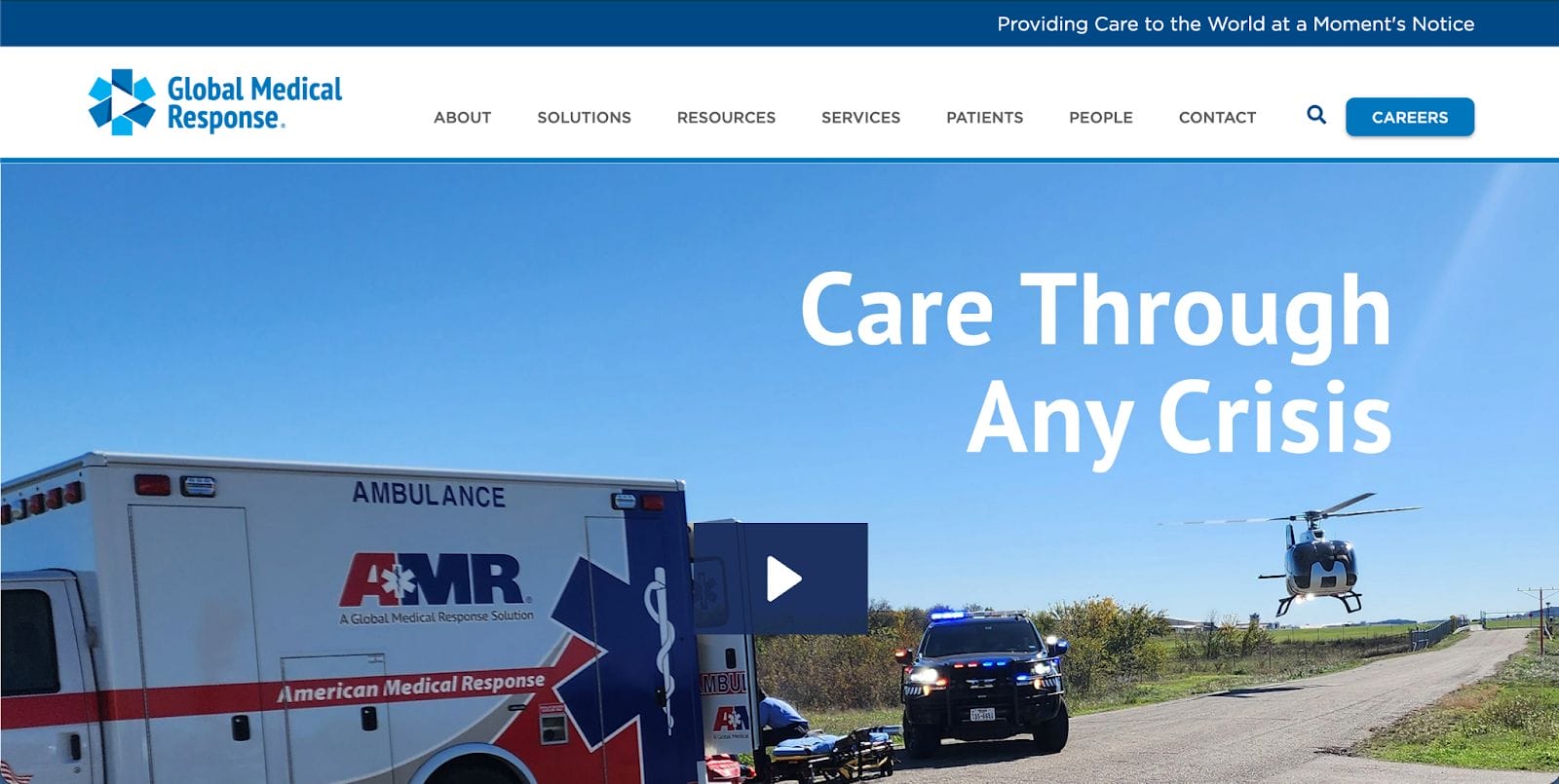
Global Medical Response provides air and land-based services, including on short notice. Team members have extensive experience and are accustomed to working with numerous partners to deliver the best care for individual patients.
The brand operates more than 350 emergency air base locations in the United States. It regularly transports patients from remote and rural settings worldwide to large hospitals and metropolitan areas, offering personalized service and a commitment to safety.
Key Features
| Provides comprehensive emergency services to over 5 million patients annually | Has 7,000+ ground vehicles and 500+ aircraft in its fleet |
| Includes nearly 34,000 employees providing multiple types of health care | Administers mobile medical care at a local, high-quality level |
3. GlobalMed Services

GlobalMed Services specializes in medical escort and stretcher services tailored to each patient and their circumstances. Company representatives combine an expert team of medical professionals, innovative equipment and a robust logistics system to meet clients’ needs during every part of the process.
The company assists numerous clients, from families to corporate entities. Employees also prioritize continuous improvement for their internal processes, which results in consistently high customer satisfaction and positive safety outcomes.
Key Features
| Responds to inquiries at any time of the day or night | Completed trips involving more than 60 countries on six continents |
| Arranges commercial stretcher service into and out of most major world cities | Frequently utilizes commercial services to prioritize affordability |
4. JET ICU

Established in 2003, JET ICU assists clients with virtually all medical transport needs. The brand’s leadership emphasizes skilled staff, continuous education and detail-oriented processes to achieve successful journeys.
The business has a legal team and representatives who engage with insurance companies on behalf of patients, minimizing out-of-pocket costs. The all-Learjet fleet maximizes patient comfort by enabling the planes to maintain a high cruising altitude, keeping them above inclement weather.
Key Features
| Usually has jets in the air within 90 minutes of receiving calls | Exercises full operational control with an in-house team |
| Maintains a flawless safety record across hundreds of domestic and international flights | Runs a 24/7 communications center for prompt service and worldwide coverage |
Methodology
Brands appeared on this list due to numerous factors that those tasked with arranging medical transport for their injured loved ones would appreciate. These included prompt service, a solid safety record, and modern fleets of air- and ground-based vehicles. Patient personalization and high-quality care were among the other meaningful aspects because those details matter during domestic and international trips.
Make Arranging Medical Transport Simpler
Many family members initially feel overwhelmed as they try to take care of the medical transport needs for their injured relatives. Partnering with an experienced company to provide that specialized support helps them feel more at ease and understand what will happen at every part of the process.
The patient and their family members can then look forward to safe, successful travels that put the injured person on the road to recovery close to home while keeping necessary care easily accessible. They can feel even more at ease when they use a reliable transportation service that caters to every need of their family member.

The Editorial Team at Healthcare Business Today is made up of experienced healthcare writers and editors, led by managing editor Daniel Casciato, who has over 25 years of experience in healthcare journalism. Since 1998, our team has delivered trusted, high-quality health and wellness content across numerous platforms.
Disclaimer: The content on this site is for general informational purposes only and is not intended as medical, legal, or financial advice. No content published here should be construed as a substitute for professional advice, diagnosis, or treatment. Always consult with a qualified healthcare or legal professional regarding your specific needs.
See our full disclaimer for more details.