Understanding the Science: How Teeth Whitening Works
A bright, confident smile can light up a room and boost your self-esteem. It’s no wonder that Teeth Whitening has become one of the most popular cosmetic dental treatments today. But with so many options available, from professional treatments to at-home kits, how do you know which method is right for you?
We are here to help you understand the distinctions. In this extensive guide, we will break down the various teeth whitening methods. We will explore how they work, their active ingredients, potential risks, and how to maintain your results. We aim to provide you with a clear understanding of these comprehensive teeth whitening options so you can make an informed decision for a brighter, healthier smile.
At its core, teeth whitening is a chemical process designed to lighten the shade of your natural teeth. This process relies on active ingredients that penetrate the enamel to break down stain molecules. To truly appreciate the differences between various methods, grasp the underlying science.
The primary active ingredients in the most effective teeth whitening products are hydrogen peroxide and carbamide peroxide. These compounds are oxidizing agents. When applied to the teeth, they release oxygen molecules. These oxygen molecules then enter the microscopic pores of enamel and dentin, where they encounter chromogens.
Chromogens are the colored compounds responsible for stains on and within your teeth. Through a process called oxidation, the oxygen molecules break down these chromogens into smaller, less pigmented, or colorless compounds. This chemical reaction effectively lightens the tooth’s overall shade, making it appear whiter. Think of it like bleaching a stained fabric – the stain isn’t scrubbed away, but somewhat chemically altered to become invisible.
Carbamide peroxide is a common choice, especially in take-home kits, because it breaks down into hydrogen peroxide and urea. This breakdown occurs more slowly than hydrogen peroxide alone, making it a gentler option that can reduce sensitivity while still providing effective whitening over time. Typically, a 10% carbamide peroxide solution is roughly equivalent to a 3.5% hydrogen peroxide solution. Hydrogen peroxide, on the other hand, acts more quickly and is often used at higher concentrations in professional in-office treatments for faster results.
It’s also crucial to distinguish between different types of stains:
- Extrinsic Stains: These are surface stains that accumulate on the outer enamel layer. They are typically caused by consuming staining foods and drinks (like coffee, tea, red wine, and dark berries), tobacco use, and certain medications. Extrinsic stains are generally easier to remove and respond well to both abrasive toothpastes and peroxide-based whiteners.
- Intrinsic Stains: These stains are embedded within the tooth structure, specifically in the dentin (the layer beneath the enamel) or deep within the enamel itself. Intrinsic stains can result from aging (as enamel thins and dentin darkens), certain medications taken during tooth development (such as tetracycline), excessive fluoride intake (fluorosis), trauma to a tooth, or even genetics. Intrinsic stains are more challenging to whiten and often require more potent, professional-grade bleaching agents and longer treatment times.
Understanding this chemical interaction and the types of stains helps us appreciate why different whitening methods yield varying results and have various application protocols. For more in-depth information on how these processes work, we encourage you to review the Latest research on whitening mechanisms.
Comprehensive Teeth Whitening Options: In-Office vs. At-Home
When considering teeth whitening, individuals typically choose between professional treatments administered by a dental professional and various at-home options. Each category offers distinct advantages, concentrations of active ingredients, and expected outcomes. Our goal is to illuminate these differences so you can choose the path that best suits your smile goals.
To effectively measure the success of any whitening treatment, dental professionals use a shade guide. This standardized chart allows us to compare the initial color of your teeth with the color achieved after treatment, often indicating improvement by several “shades.” The degree of shade improvement varies significantly depending on the method used, your initial tooth shade, and the type of stains present.
It’s also essential to understand the terms “vital bleaching” and “non-vital bleaching.” Vital bleaching is performed on “living” teeth, meaning teeth with healthy pulp tissue, to address discoloration from extrinsic or intrinsic stains. This is the most common type of whitening. Non-vital bleaching, conversely, is used for teeth that are no longer “alive,” typically after a root canal treatment, where the tooth has darkened from the inside. This internal bleaching method targets discoloration from within the tooth structure.

Professional In-Office Treatments
Professional in-office teeth whitening, often called “chairside bleaching,” offers the most rapid and dramatic results. These treatments are performed under the direct supervision of a dentist, allowing for the use of higher concentrations of whitening agents and specialized equipment.
- Peroxide Concentration: In-office treatments typically utilize hydrogen peroxide concentrations ranging from 15% to 43%. This significantly higher concentration, compared to at-home products, allows for faster and more pronounced whitening effects.
- Application Process: Before applying the whitening gel, your dentist will carefully protect your gums and other soft tissues with a protective barrier, such as a gel or rubber dam. This prevents irritation and chemical burns from the high-concentration peroxide. The whitening gel is then applied directly to the tooth surfaces.
- Light/Heat Activation: Many in-office systems incorporate a special light, laser, or heat source to accelerate the whitening gel’s chemical reaction. While the effectiveness of light activation remains debated in some scientific circles, it is often marketed as a way to achieve faster, deeper whitening in a single appointment.
- Results and Timeframe: The most significant advantage of in-office whitening is its immediacy. Patients can often see their teeth lighten by 3 to 8 shades in just 1 or a few 30- to 60-minute sessions. While dramatic, it’s worth noting that nearly half of the initial color change from an intensive in-office treatment may be lost within 7 days, underscoring the importance of maintenance.
- Cost and Supervision: Due to the higher concentration of active ingredients, specialized equipment, and professional time involved, in-office treatments are generally more expensive than at-home options. However, the direct supervision of a dentist ensures safety and allows for immediate adjustments if sensitivity or other issues arise.
At-Home Comprehensive Teeth Whitening Options
At-home whitening methods offer a convenient, often more affordable alternative to in-office treatments. These options vary in their application, concentration, and the speed of results.
- Custom Trays (Dentist-Provided): This method involves your dentist taking impressions of your teeth to create custom-fitted whitening trays. You are then provided with a professional-grade whitening gel, typically containing 10% to 16% carbamide peroxide (equivalent to 3.5% to 5.76% hydrogen peroxide). The trays are worn for a specified period each day, usually for several weeks. The custom fit ensures the gel stays on your teeth and minimizes contact with your gums, reducing irritation. This method offers gradual yet effective whitening, often achieving results similar to in-office treatments over a more extended period.
- Whitening Strips: Widely available over-the-counter, whitening strips are thin, flexible plastic strips coated with a peroxide-based whitening gel. They are applied directly to the teeth for a set amount of time, usually once or twice a day for 10 to 14 days. Strips are convenient and can lighten teeth by one or two shades, with results lasting several months. Their constant contact with the tooth surface is a key factor in their effectiveness.
- Whitening Gels (Paint-on): These gels are applied directly to the tooth surface with a small brush. They are less messy than strips for some, but their effectiveness can vary depending on how consistently the gel remains on the teeth and the concentration of the active ingredient.
- Whitening Toothpastes and Rinses: These products primarily work by removing extrinsic surface stains through mild abrasives or chemical agents. While they can make your teeth appear brighter by cleaning the surface, they typically do not contain enough peroxide to change the intrinsic color of your teeth significantly. They are best used for maintaining results after a professional whitening treatment or for very mild surface stain removal.
- Peroxide Concentration: Over-the-counter at-home whitening products generally contain lower concentrations of peroxide, typically ranging from 3% to 20% (either hydrogen or carbamide peroxide). This lower concentration makes them safer for unsupervised use, but means results are more gradual and less dramatic than professional treatments.
- ADA Seal of Acceptance: When choosing at-home products, we recommend looking for those with the American Dental Association (ADA) Seal of Acceptance. This seal indicates that the product has been tested for safety and effectiveness for its intended use, providing an extra layer of assurance for consumers.
Whether you opt for the immediate impact of an in-office procedure or the gradual convenience of an at-home system, understanding these differences is key to making an informed decision about your smile. For a full spectrum of choices and a personalized plan, explore our comprehensive teeth whitening options.
Whitening Method Peroxide Concentration Treatment Time Shade Improvement In-Office 15-43% Hydrogen Peroxide 1-2 hours (1-3 visits) 3-8 shades Dentist-Provided Trays 10-16% Carbamide Peroxide Weeks (daily use) 2-6 shades OTC Strips/Gels 3-20% Peroxide 10-14 days (daily use) 1-2 shades 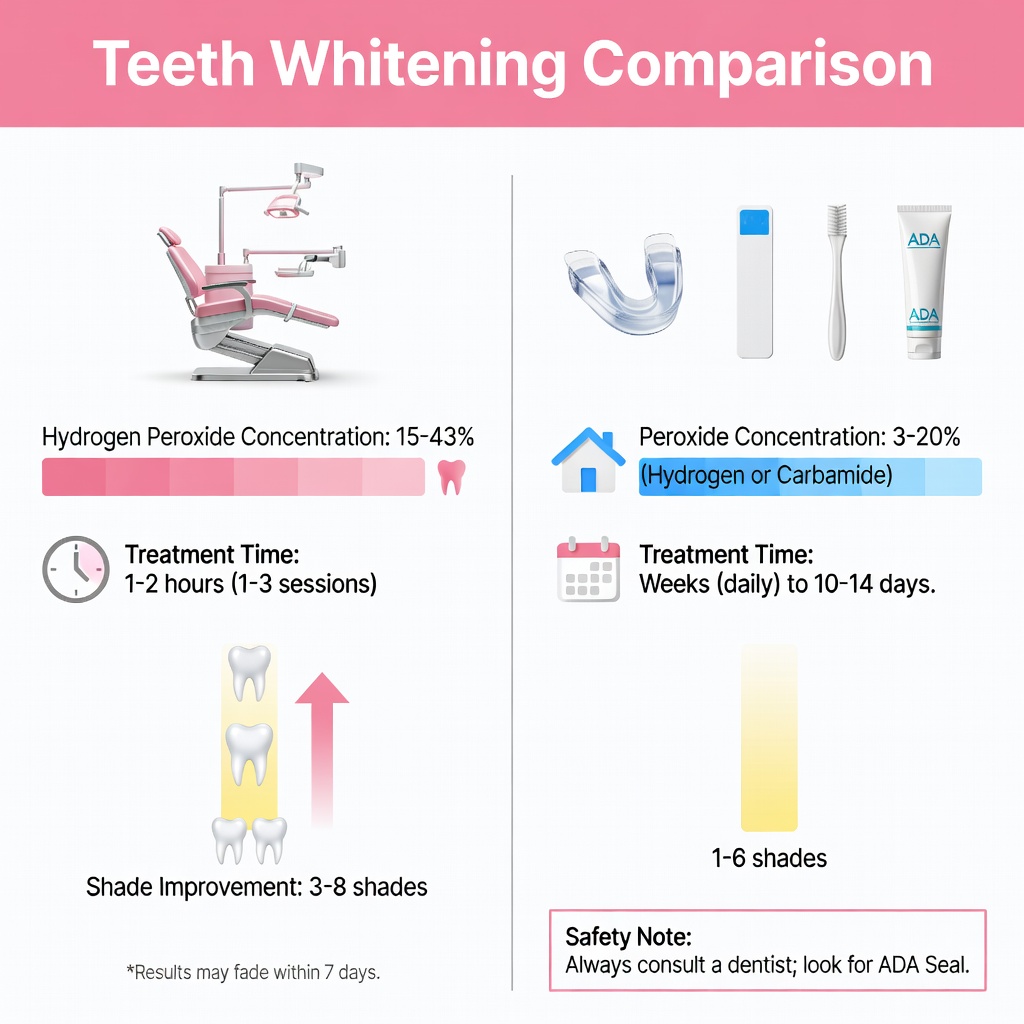
Safety, Risks, and Regulatory Considerations
While the desire for a brighter smile is strong, it’s paramount to approach teeth whitening with an understanding of its potential risks and the regulatory landscape designed to protect consumers. The safety of teeth whitening products largely depends on the concentration of the active ingredients, the application method, and the individual’s oral health status.
The most common side effects associated with teeth whitening are:
- Tooth Sensitivity: This typically manifests as a temporary increase in sensitivity to hot, cold, or sweet stimuli. It occurs when the peroxide penetrates the enamel and dentin, irritating the nerve within the tooth. The incidence of sensitivity can range from 67% to 78% among individuals who receive intensive in-office treatments, mainly when heat is used. This sensitivity is usually transient, resolving within a few days post-treatment.
- Gingival Irritation: The whitening gel can sometimes come into contact with the gums and other soft tissues in the mouth, leading to temporary irritation, redness, or even white patches. This is more common with ill-fitting trays or improper application of at-home products. Professional application methods are designed to minimize this risk by carefully isolating soft tissues.
- Enamel Damage: Concerns about irreversible enamel damage from whitening are often raised. While proper use of approved whitening products is generally considered safe for enamel, overuse or misuse of highly acidic or abrasive products can potentially lead to enamel erosion or increased surface roughness. It’s crucial to follow instructions carefully and consult with a dental professional.
Regulatory Oversight:
Different countries and regions have established regulations to ensure the safety of teeth whitening products. These regulations often dictate the maximum permissible concentration of peroxide in products available to consumers versus those used by dental professionals.
- US Food and Drug Administration (FDA): In the United States, the FDA classifies teeth whitening products as cosmetics. They endorse gels containing 6% hydrogen peroxide or 16% carbamide peroxide or less for over-the-counter use. Products with higher concentrations are typically restricted to professional dental settings.
- Health Canada: In Canada, tooth-whitening products (unless they contain fluoride) are also considered cosmetics. Manufacturers and importers are responsible for ensuring the safety of their products and must submit a cosmetic notification form to Health Canada. While Health Canada reviews these notifications to ensure safety concerns are addressed, it does not “approve” cosmetic products in the same way it does drugs. They actively monitor product safety and may perform testing if adverse reaction patterns emerge. For a detailed guide on the safe use of at-home kits, refer to Health Canada’s information on the Safe use of home kits.
- European Union (EU): The EU has stricter regulations that limit the concentration of hydrogen peroxide in products available to the public to 0.1%. Products containing 0.1% to 6% hydrogen peroxide can only be sold to dental practitioners and must not be supplied directly to consumers. This stringent approach emphasizes professional supervision for higher-concentration treatments.
Minimizing Risks:
To minimize the risks and side effects associated with teeth whitening, we strongly recommend:
- Consult a Dental Professional: Always consult with a dentist before starting any whitening regimen. They can assess your oral health, identify the cause of discoloration, and recommend the most appropriate and safest method for you. This is especially important if you have pre-existing conditions like gum disease, unfilled cavities, sensitive teeth, or if you are pregnant or breastfeeding.
- Follow Instructions Diligently: Adhere strictly to the manufacturer’s instructions for at-home products, including application time and frequency.
- Use ADA Seal Products: For over-the-counter options, choose products that have earned the ADA Seal of Acceptance, as this signifies they meet specific safety and efficacy standards.
- Manage Sensitivity: If sensitivity occurs, consider reducing use frequency, shortening application time, or using desensitizing toothpastes. If sensitivity persists or is severe, discontinue use and contact your dentist.
- Report Adverse Reactions: If you experience any severe or prolonged adverse reactions, seek medical attention and report the incident to the relevant regulatory authorities, such as Health Canada’s Regional Product Safety Office.
By being informed and proactive, you can achieve a brighter smile while safeguarding your oral health.
Maximizing the Longevity of Your Results
Achieving a whiter smile is a fantastic feeling, but maintaining those results requires ongoing effort and wise choices. Teeth whitening is not a permanent solution; over time, your teeth will naturally begin to re-stain. Understanding the factors that contribute to this re-staining and adopting good habits can significantly extend the brilliance of your smile.
Several factors influence how quickly your teeth lose their whitened appearance:
- Dietary Habits: Consuming staining foods and drinks is a primary culprit. Coffee, tea, red wine, dark sodas, berries, soy sauce, and highly pigmented sauces can all contribute to extrinsic stains. These chromogens, which were broken down during the whitening process, will begin to accumulate again on the enamel surface.
- Tobacco Use: Smoking or using other tobacco products is one of the most significant contributors to tooth discoloration. Tar and nicotine create stubborn brown and yellow stains that can quickly diminish whitening results.
- Oral Hygiene: Inadequate brushing and flossing allow plaque and biofilms to accumulate, which can absorb stains more readily and make teeth appear dull.
- Age and Natural Processes: As we age, our tooth enamel naturally thins, allowing more of the yellowish dentin underneath to show through. Additionally, secondary dentin formation occurs throughout life, which can also contribute to a darker tooth shade. These natural processes mean that while whitening can reverse some age-related darkening, it cannot halt the underlying biological changes.
- Type of Stains: Teeth whitened by extrinsic stains may maintain their brightness longer with good habits, whereas those with deep intrinsic stains may return to their previous shade more quickly.
Maintaining Your Results with Comprehensive Teeth Whitening Options
To keep your smile looking its best after a whitening treatment, consider incorporating these strategies:
- Excellent Oral Hygiene: The foundation of a lasting white smile. Brush at least twice a day with a fluoride toothpaste and floss daily to remove plaque and prevent stain accumulation.
- Strategic Diet: Minimize your consumption of highly staining foods and beverages. If you do indulge, consider drinking dark liquids through a straw to reduce contact with your front teeth. Rinsing your mouth with water immediately after consuming staining items can also help.
- Regular Professional Cleanings: Visiting your dentist or hygienist for routine professional cleanings (typically every six months) is crucial. These cleanings remove extrinsic stains and tartar buildup that at-home brushing cannot, helping to maintain your bright smile.
- Touch-Up Kits: Many dentists offer custom-tray touch-up kits with lower-concentration whitening gel. Using these periodically, as recommended by your dentist, can effectively combat new stains and refresh your results.
- Whitening Toothpastes and Rinses: While not powerful enough to change the intrinsic color of your teeth, whitening toothpastes and rinses can help remove surface stains and extend the life of your professional whitening. Look for products with the ADA Seal of Acceptance for stain removal.
- Avoid Tobacco: Quitting smoking or other tobacco use is arguably the most impactful step you can take to prevent future staining and maintain your whitened teeth.
- Consider Non-Peroxide Alternatives: For daily maintenance or for individuals with extreme sensitivity, some non-peroxide alternatives, such as certain natural ingredients (e.g., baking soda), can help remove surface stains without the chemical bleaching action. Baking soda, in particular, is a mild abrasive that can help polish away surface stains.
By integrating these practices into your daily routine, you can significantly prolong the effects of your teeth whitening treatment and enjoy a radiant smile for much longer. For further guidance on keeping your smile bright, the American Dental Association offers valuable insights on maintaining white teeth.
Frequently Asked Questions about Teeth Whitening
We understand that you might have several questions when considering teeth whitening. Here, we address some of the most common concerns to provide clarity and help you make informed decisions.
Can whitening damage my crowns, veneers, or fillings?
This is a fundamental question, and the answer is a definitive no: whitening agents do not change the color of existing dental restorations. Teeth whitening products, whether hydrogen peroxide or carbamide peroxide-based, are designed to work only on natural tooth structure. Materials like porcelain, ceramics, composite resin fillings, and dental gold are not affected by the oxidizing agents.
What this means in practice is that if you have crowns, veneers, or fillings on your front teeth, they will retain their original color while your natural teeth whiten. This can result in a noticeable shade mismatch, making your restorations stand out against your newly brightened natural teeth. Therefore, if you are considering teeth whitening and have existing dental work in visible areas, it’s crucial to discuss this with your dentist. They may recommend whitening your natural teeth first and then replacing your existing restorations to match your new, brighter smile. This ensures a uniform and aesthetically pleasing result.
What is the difference between ‘whitening’ and ‘bleaching’?
While often used interchangeably in everyday conversation, the terms “whitening” and “bleaching” have distinct meanings within the dental community, particularly as defined by organizations such as the American Dental Association (ADA).
- Whitening: This term generally refers to restoring the natural tooth color by removing surface stains. Products categorized as “whiteners” typically use mild abrasives or mechanical action to polish away extrinsic stains without altering the tooth’s intrinsic color. Whitening toothpastes are a prime example of this category; they work by scrubbing away surface discoloration.
- Bleaching: This term refers to products containing peroxide-based ingredients (hydrogen peroxide or carbamide peroxide) that actually change the tooth’s intrinsic color. These agents penetrate the enamel to break down chromogens, making the teeth genuinely lighter than their original natural shade. When someone says their teeth are “bleached,” it implies that a chemical process has lightened the tooth’s internal color.
So, while all bleaching agents whiten teeth, not all whitening products bleach them. Understanding this distinction helps you choose the right product for your specific needs and manage expectations for the results. If you’re looking for a significant change beyond surface stain removal, you need a bleaching treatment.
Who should consult a dental professional before whitening?
While teeth whitening is generally safe for many individuals, certain conditions and circumstances warrant a consultation with a dental professional before undergoing any treatment:
- Pregnancy and Breastfeeding: The safety of teeth whitening agents during pregnancy and breastfeeding has not been definitively established. As a precautionary measure, most dental professionals advise against whitening during these periods.
- Gum Disease or Unfilled Cavities: If you have active gum disease (gingivitis or periodontitis), exposed tooth roots, or untreated cavities, applying whitening agents can cause severe pain, irritation, or even damage. These oral health issues must be addressed and resolved before considering whitening.
- Pre-existing Tooth Sensitivity: Individuals who already experience tooth sensitivity may find that whitening treatments exacerbate this condition. A dentist can assess the cause of your sensitivity, recommend strategies to minimize discomfort, or suggest alternative therapies.
- Children Under 16: The pulp chamber (the living part of the tooth containing nerves and blood vessels) is larger in children and adolescents. Whitening agents can irritate or damage this sensitive tissue. Therefore, teeth whitening is generally not recommended for individuals under 16.
- Allergies to Peroxide: Although rare, some individuals may be allergic to peroxide. A consultation can help identify such sensitivities.
- Unrealistic Expectations: A dental professional can provide a realistic assessment of what whitening can achieve for your specific tooth shade and stain types, helping to manage expectations and prevent disappointment.
- Specific Types of Stains: Some intrinsic stains, such as severe tetracycline staining or fluorosis, may not respond well to conventional whitening and may require alternative cosmetic treatment, such as veneers.
A thorough dental examination ensures that your teeth and gums are healthy enough for whitening and that the chosen method is appropriate and safe for your individual needs.
Conclusion
Navigating teeth whitening can seem complex, but with the correct information, you can make confident choices for your smile. We’ve explored the science behind how whitening agents work, differentiating between hydrogen and carbamide peroxide and their oxidation process on chromogens. We’ve also delved into the diverse array of options available, from the immediat,d potent results of professional in-office treatments to the convenien,d gradual effects of various at-home systems, including custom trays and whitening strips.
Understanding potential risks, such as temporary sensitivity and gum irritation, and being aware of regulatory guidelines from bodies like Health Canada and the US FDAempowers you to prioritize safety. Furthermore, we’ve outlined practical strategies for maintaining your dazzling results, emphasizing good oral hygiene, dietary awareness, and regular dental check-ups.
Whether you’re seeking a dramatic transformation or a subtle brightening, the path to a whiter smile should always begin with informed decisions and, ideally, professional guidance. As Dr. Janne Lynch and the team at AZ Dentist in Scottsdale, Glendale, Sun City, and Sedona, we are dedicated to providing personalized dental care that not only enhances the aesthetic quality of your life but also safeguards your oral health. A brighter smile is within reach, and we are here to help you achieve it safely and effectively.

The Editorial Team at Healthcare Business Today is made up of experienced healthcare writers and editors, led by managing editor Daniel Casciato, who has over 25 years of experience in healthcare journalism. Since 1998, our team has delivered trusted, high-quality health and wellness content across numerous platforms.
Disclaimer: The content on this site is for general informational purposes only and is not intended as medical, legal, or financial advice. No content published here should be construed as a substitute for professional advice, diagnosis, or treatment. Always consult with a qualified healthcare or legal professional regarding your specific needs.
See our full disclaimer for more details.