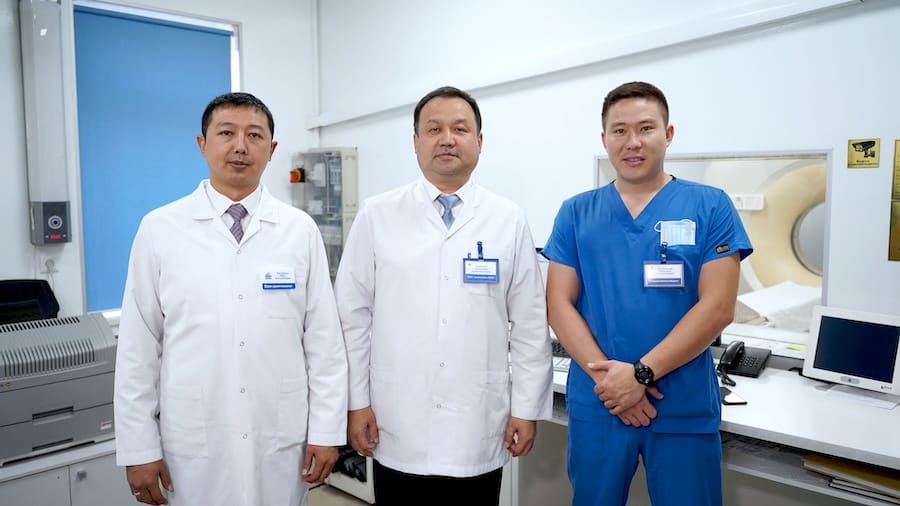
From military medical major to internationally-trained radiologist – a Kyrgyz doctor’s career reveals the competencies physicians need in an era of crises
Radiology is a cornerstone of modern healthcare: specialists in this field are involved in 80% of patient-physician interactions, from emergency care to routine treatment. That’s why the shortage of radiologists has become one of the most vulnerable points in healthcare systems worldwide. The demand for CT, MRI, and X-ray examinations is growing far faster than the number of specialists available to perform them. In resource-limited countries, this gap is particularly acute: the workload on each physician increases while the cost of diagnostic errors rises.
In response to these challenges, a new type of radiologist is emerging – professionals with technological competence, clinical thinking, and the ability to work effectively under difficult conditions. In regional healthcare systems, such specialists often become the backbone of the entire diagnostic service. Zhyrgalbek Zhakypov, a radiologist from Bishkek, the capital of the Kyrgyz Republic, belongs to this category. A general practitioner, infectious disease specialist, and medical major with experience in conflict zones and pandemic red zones, he has performed approximately 16,000 CT scans over the past three years. Zhyrgalbek Zhakypov’s career demonstrates how individual specialists with broad competencies sustain healthcare systems amid staff shortages and recurring social crises.
Technology: CT and MRI as Early Diagnostic Tools
In conditions of acute radiologist shortage, early diagnosis is critically important: timely disease detection can significantly impact survival rates and save healthcare resources. As a radiologist at Bishkek’s largest diagnostic center, Zhyrgalbek Zhakypov implements advanced standards in diagnosing the most dangerous diseases, including cancer, helping to change troubling statistics: Kyrgyzstan currently has more than 33,400 cancer cases.
Over three years, the specialist notes, he has performed more than 15,800 examinations on the latest generation multi-slice CT systems. A key focus of his practice is detecting pathologies at preclinical and early stages. For instance, Dr. Zhakypov performs daily high-precision mammography with 3D tomosynthesis, enabling timely breast cancer detection, and low-dose computed tomography – the only lung cancer screening method that ensures significant mortality reduction when detected early.
The specialist’s expertise extends far beyond oncological disease detection. CT angiography allows Zhyrgalbek Zhakypov to identify vascular aneurysms and thromboses in their early stages, while densitometry helps diagnose the first symptoms of osteoporosis. Thus, radiological diagnostics in his practice serves as a preventive tool, not merely a means of confirming diagnoses.
In his work, Dr. Zhakypov adheres to the ALARA principle (As Low As Reasonably Achievable), which holds particular significance in countries like Kyrgyzstan, where medical digitization is far from complete.
“In a fragmented healthcare system, radiologists often lack information about a patient’s previous radiation exposure, so we conduct each examination as if it’s neither the first nor the last in the diagnostic chain,” explains Zhyrgalbek Zhakypov.
This approach is especially important for regions where limited access to high-tech care demands the most responsible use of every diagnostic resource. In the hands of specialists like Zhyrgalbek Zhakypov, CT and MRI become elements of systematic prevention: early disease detection directly reduces mortality and healthcare burden.

Multidisciplinarity: From General Practitioner to Radiologist
Against the backdrop of a global radiologist shortage, specialists capable of working at the intersection of disciplines become particularly valuable. Analysts predict the radiologist shortage will only intensify. Under such conditions, physicians who can interpret images not in isolation but within clinical context become critically important.
Zhyrgalbek Zhakypov has an unusual career trajectory. He started as a general practitioner, then specialized in infectious diseases, and from 2002 to 2021 progressed from military physician to medical major, leading medical units in the army and Ministry of Internal Affairs. This experience developed clinical thinking that extends beyond a single specialty.
His transition to civilian medicine, joining the Association of Radiologists of the Kyrgyz Republic, participating in the professional community, and continuous education allowed Zhyrgalbek Zhakypov to integrate his accumulated clinical experience with modern radiological protocols. Two decades of diverse practice shaped a specialist capable of seeing not isolated changes on scans but a complete picture of disease. This is especially important in cases where radiological findings are ambiguous and may correspond to different clinical scenarios.
For example, working with multi-slice CT, Zhyrgalbek Zhakypov daily analyzes studies comprising thousands of slices covering multiple anatomical zones. When evaluating lung changes, the expert considers not only the morphology of lesions but also their probable infectious, autoimmune, or vascular nature. When detecting mass lesions, he correlates imaging data with possible systemic diseases, metabolic disorders, and the patient’s comorbidities.
Zhyrgalbek Zhakypov’s multidisciplinary approach leads to regular detection of vascular pathologies, early manifestations of interstitial lung diseases, and systemic processes in their initial stages. The ability to address multiple diagnostic tasks simultaneously allows for reducing repeat examinations, optimizing the entire system’s workflow.
Working in Extreme Conditions as a Test of Competence
Any healthcare system is designed for standard conditions. But crises – such as military conflicts and pandemics – quickly expose its weak points. In such situations, the key factor becomes not only the availability of modern equipment but also the presence of specialists who can work under extreme conditions.
Zhyrgalbek Zhakypov has repeatedly worked under stress and uncertainty, when the cost of error is particularly high. In 2010, when Kyrgyzstan was experiencing a political crisis and a series of interethnic clashes, Dr. Zhakypov, as a military medic, provided care to victims in conflict zones.
“Hundreds died, thousands were wounded. Working in hot spots taught me a great deal, such as instantaneous assessment of polytrauma situations, when you need to determine the nature of internal organ damage within minutes,” the specialist says.
A decade later, when Kyrgyzstan found itself among the most affected countries (in July 2020, according to some data, it ranked first globally in mortality rates), Zhyrgalbek Zhakypov was again on the front lines – in the “red zone,” where CT served as a first-line diagnostic tool. With limited resources and high mortality, the speed and accuracy of radiological findings determined subsequent treatment strategies.
The ability to maintain effectiveness under tremendous physical and mental strain, to distinguish essential from secondary, psychological resilience – these skills helped Zhyrgalbek Zhakypov survive the pandemic and remain in the profession when his colleagues were leaving medicine en masse due to burnout.
Today, the diagnostic services market in Central Asia is growing, but its sustainability is determined not only by investments but by the quality of human capital. Each of the nearly 16,000 examinations performed by Zhyrgalbek Zhakypov is an example of how, under resource-limited conditions, the healthcare system is sustained through the experience, clinical thinking, and approach of individual physicians.

Meet Abby, a passionate health product reviewer with years of experience in the field. Abby's love for health and wellness started at a young age, and she has made it her life mission to find the best products to help people achieve optimal health. She has a Bachelor's degree in Nutrition and Dietetics and has worked in various health institutions as a Nutritionist.
Her expertise in the field has made her a trusted voice in the health community. She regularly writes product reviews and provides nutrition tips, and advice that helps her followers make informed decisions about their health. In her free time, Abby enjoys exploring new hiking trails and trying new recipes in her kitchen to support her healthy lifestyle.
Please note: This article is for informational purposes only and does not constitute medical, legal, or financial advice. Always consult a qualified professional before making any decisions based on this content. See our full disclaimer for more information.