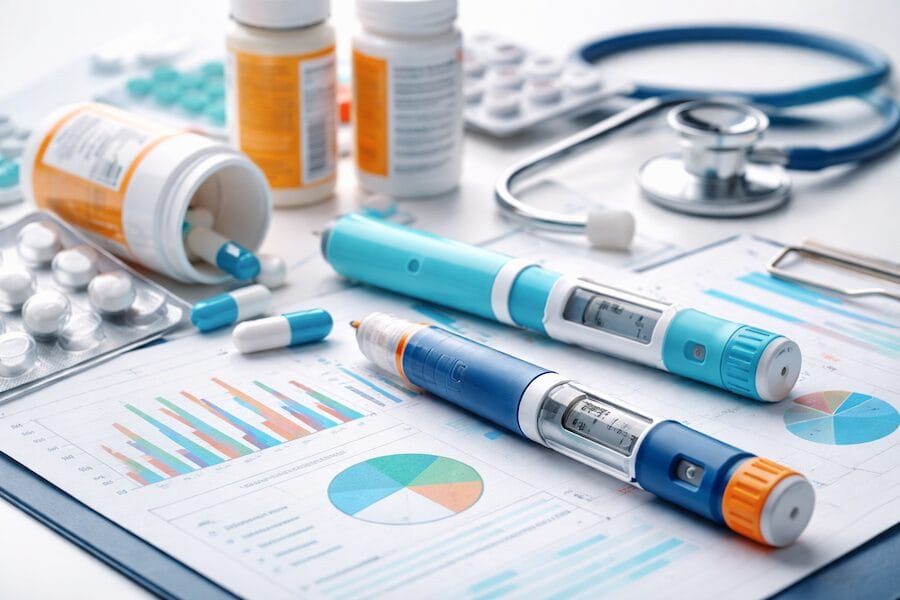
Glucagon-Like Peptide-1 (GLP-1) receptor agonists’ soaring popularity as a weight-loss aid (More than a third of patients on Wegovy pill are new to GLP-1 drugs, study finds, Reuters, 11 February 2026 (study by health data firm Truveta, among early users of Novo Nordisk’s Wegovy weight-loss pill) has overwhelmed the pharma industry, which is seeing unforeseen volumes of new safety work as the products’ success continues to go viral internationally (IQVIA Market Analysis, 5 January 2026). Potential safety areas being closely monitored at present include pancreatitis (GLP-1 receptor agonists and dual GLP-1/GIP receptor agonists: strengthened warnings on acute pancreatitis, including necrotising and fatal cases, UK MHRA, 29 January 2026) and ocular issues (PRAC concludes eye condition NAION is a very rare side effect of semaglutide medicines Ozempic, Rybelsus and Wegovy, European Medicines Agency, 6 June 2025).
Current pharmacovigilance (PV) systems are struggling to cope with soaring adverse event caseloads, and their inherent complexity. Where GLP-1 products take the form of injectables (combination products), there is the added complication of possible device failures, for instance. These can trigger complaints that are peripheral to the medication itself, adding to the PV workload and potentially clouding drug-related safety insights.
The growing off-label use of GLP-1 therapies (Microdosing: how ‘off-label’ use of weight loss jabs is spreading from US to UK, The Guardian, July 2025: (see also https://pmc.ncbi.nlm.nih.gov/articles/PMC12151216/#sec0005) adds a further dimension still. Here, patients may have deviated from approved dosing regimens, raising concerns about both safety and efficacy – as these factors have not been thoroughly evaluated in clinical trials. This practice may also lead to an increased volume of adverse event (AE) reports outside the context of the drug’s approved clinical use.
Drawing new attention to long-standing process problems
Volumes of incoming safety reports following product launches in the GLP-1 therapy class (Side effects of GLP-1 receptor agonists, British Medical Journal, August 2025: Exploring potential associations between GLP-1RAs and depressive disorders: a pharmacovigilance study based on FAERS and VigiBase data, The Lancet, August 2025) are highlighting the limitations of current systems and approaches to case intake and processing. Traditional system-supported PV workflows, which involve teams being scaled up to cope with extra demand, were built around relatively predictable patterns of adverse event reporting, primarily via healthcare professionals. They also assume clear distinctions between drug-related adverse events and device-related product complaints.
GLP-1 products have challenged these parameters. The products have been taken up quickly and widely, and real-world side effects are only now emerging. These are being reported directly by patients, recorded by frontline care providers and pharmacists, fed back by drug sales teams, and captured as part of patient support programs (PSPs). Information is being captured in a multitude of ways, across an array of different channels and sources (some of which may be duplicated), and “in the moment” opportunities to ask key follow-up questions can be missed. This diversity and inconsistency in reporting is leading to delays in drawing critical insights together, with implications both for regulatory compliance (critical signals must be reported swiftly) and ultimately for patient safety.
Categorizing issues consistently and accurately
Early GLP-1 weight-loss drugs (injectables) have a medical device element. These combination products are administered by patients at home, without medical supervision. This can cloud the source of any issue, when reporting via a physician, pharmacist or PSP contact. Was it a faulty injector, or the drug itself? The patient may simply want to register a complaint, but the pharma company requires more detail to fulfil its regulatory reporting obligations, contain risk and keep patients safe.
The limitations of manual PV processes become particularly acute at scale. Take a single adverse event case that requires assessment and distribution to multiple regulatory bodies. Each distribution requires careful data entry, quality checking and regulatory submission within strict timelines. Multiply this by thousands of cases monthly, and long-standing manual approaches soon come undone.
The familiar challenge of patient follow-up (capturing a fuller history) is magnified in the context of GLP-1s. If follow-up questions aren’t asked at the time of initial reporting, the opportunity to capture full and rich detail – which may be important for downstream analysis – may be irretrievably lost. In the context of GLP-1s’ mass-scale take-up, reliance on after the fact gap-filling is both impractical and risky from a safety perspective. All of this needs to be addressed head on, rather than worked around.
This is just the beginning
The current GLP-1 PV challenge is a sign of what’s to come. The trend towards combination products, and towards patient self-administration will only grow given the convenience it offers patients and the pressure on healthcare systems to back routine medication administration at home. As part of this shift, data and the processes used to capture it must be more consistent, and more seamless than they have been up to now.
The more ambitious the therapies being rolled out to patients, the more critical it is that genuine signals can be identified, qualified and circulated swiftly. This will necessitate optimized safety intake process automation. Companies that continue to rely on increased team sizes to handle peaks in case volumes risk being perpetually overwhelmed. They could also miss critical safety signals and fall foul of regulatory timelines.
About the author
Daniel O’Keeffe specializes in transforming pharmacovigilance through cutting-edge technology. Qinecsa is a global provider of innovative, digital pharmacovigilance solutions, including cloud-based analytics solutions and services for medical research and healthcare delivery.

Daniel O’Keeffe
Daniel O’Keeffe specializes in transforming pharmacovigilance through cutting-edge technology. Qinecsa is a global provider of innovative, digital pharmacovigilance solutions, including cloud-based analytics solutions and services for medical research and healthcare delivery.