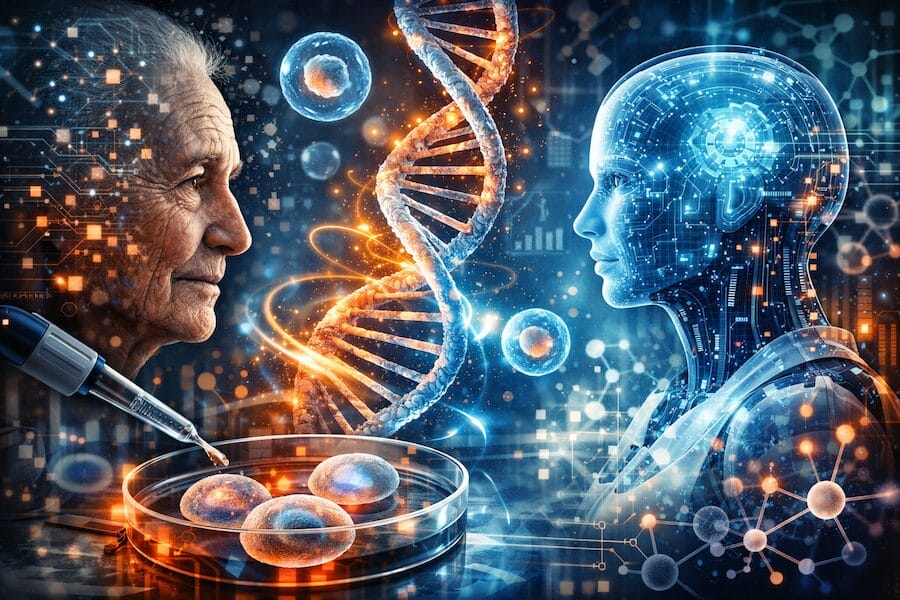
For decades, the idea of resetting the biological clock sounded more like speculative fiction than clinical strategy. The discovery of Yamanaka factors by Nobel laureate Shinya Yamanaka, which can reprogram adult cells into induced pluripotent stem cells, ignited serious scientific interest in whether aging might be partially reversible. However, translating this science into human therapies remained out of reach due to safety concerns, inefficiency, and biological complexity.
In 2026, that frontier is moving from theory to regulated clinical testing, laying the groundwork for measurable applications of cellular rejuvenation.
2026: The First Human Test of Cellular Rejuvenation
The U.S. Food and Drug Administration has approved Life Biosciences’ Investigational New Drug (IND) application for ER-100. This partial epigenetic reprogramming therapy is based on three Yamanaka factors: OCT4, SOX2, and KLF4, or OSK. This marks the first human clinical trial of a targeted cellular rejuvenation approach using reprogramming technology.
For longevity science, regulatory approval, not laboratory proof, is the true inflection point.
The trial will initially focus on optic neuropathies, such as glaucoma and non-arteritic anterior ischemic optic neuropathy (NAION). These conditions cause vision loss in older adults. Researchers will evaluate whether transient reprogramming can restore youthful epigenetic patterns in diseased cells without compromising cellular identity or increasing oncogenic risk.
Treating Age-Related Disease at the Source
This is not an attempt at wholesale age reversal. Rather, it is a targeted intervention for age-related disease, based on David Sinclair’s information theory of aging. This theory attributes cellular decline to the accumulation of epigenetic noise.
Preclinical studies demonstrated significant vision restoration in aged and blind mice. The current trial will determine if these results translate to humans.
By focusing on outcomes such as vision restoration and optic nerve function, and by defining safety measures, cellular reprogramming is now held to real-world standards.
The field is shifting from conceptual promise to measurable, patient-centered endpoints.
AI as the Acceleration
AI is accelerating progress in this field, enabling practical breakthroughs. In 2025, OpenAI and Retro Biosciences deployed GPT-4b micro, a specialized biology-focused model derived from GPT-4o. This collaboration produced redesigned Yamanaka factor variants, namely RetroSOX and RetroKLF. These achieved over 50-fold higher expression of stem cell reprogramming markers in vitro compared to wild-type controls. They also improved DNA repair.
What once required weeks of iterative laboratory optimization can now be modeled, redesigned, and refined computationally, compressing development timelines while improving precision.
Moving Beyond Trial-and-Error Biology
This is more than laboratory optimization. AI is converting decades of trial-and-error biology into scalable, predictive insight.
It identifies optimal protein sequences, predicts safety profiles, and reduces clinical risk. Retro Biosciences is advancing broader uses. The Life Biosciences trial establishes a regulatory precedent.
As a healthcare venture capitalist with over a decade of experience, including roles at Qualcomm Ventures and Providence Ventures, I have seen AI evolve. It has moved from experimental pilots to a central engine of therapeutic innovation.
In 2026, investments are focused on AI that not only identifies novel targets but also reduces risk in complex interventions, such as partial reprogramming for age-related diseases. Capital is increasingly directed toward platforms that de-risk complex biology while targeting root causes of chronic decline, not merely symptom management.
Why This Moment Is Different
Restoring vision in elderly populations brings direct economic value. Improved mobility lowers fall risk, reduces healthcare utilization, and supports prolonged independence.
As investors, we see reprogramming as infrastructure for sustainable, investable aging societies enabling healthier populations, moderated system costs, and extended workforce participation.
The Shift from Theory to Reality
Longevity research is shifting from hype to substantiated progress, driven by science, regulatory approvals, and AI. The first human reprogramming trial marks a turning point: aging is being addressed as a treatable clinical issue, not just a theoretical one.
The question is no longer whether cellular rejuvenation is possible in principle. It is whether we can scale it safely, responsibly, and equitably.
While the notion of resetting aspects of the biological clock may once have sounded speculative, today, it is being tested under FDA oversight, with defined endpoints and measurable outcomes. That shift, from imagination to implementation, is what makes 2026 a defining year for longevity science.

Thomas Kluz
Thomas Kluz is a distinguished venture capitalist with over a decade of experience. He’s the Managing Director of Niterra Ventures, where his investments focus on energy, mobility, and healthcare. With deep expertise in healthcare-focused venture capital, he has a proven track record of success with various organizations, such as Qualcomm Ventures and Providence Ventures.